
After planning a trip on a map, it can be useful to distinguish arcades researched from arcades actually visited. Searches and favorites alone do not reliably provide that distinction or the visit date. In October, Musecat connected on-site GPS checks to account stamps and a passport for reviewing visits through statistics and maps.
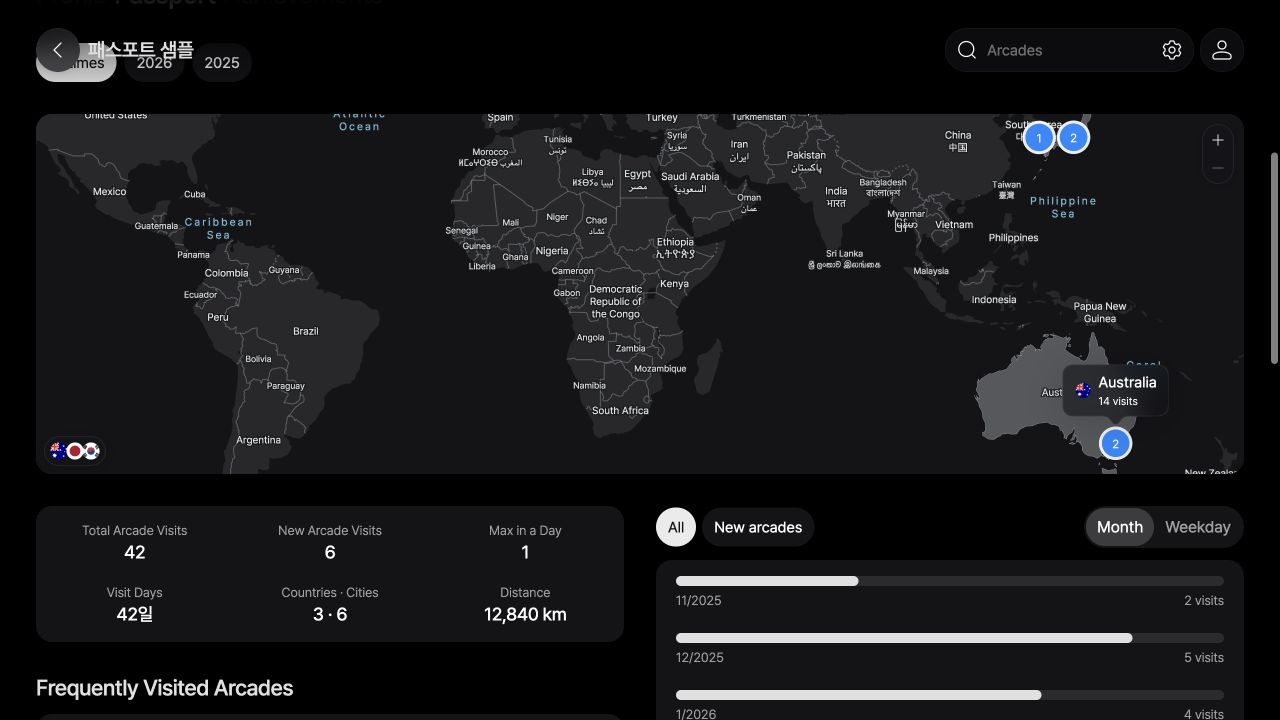
Actual profile Passport UI in English, populated with synthetic data (42 visits, 6 fictional venues, 3 countries).
Location search and visit stamps
Selecting a region and browsing the map help find places to go. For example, opening several arcade pages while planning an overseas route does not mean visiting them all. Favorites can also contain both future destinations and familiar places.
A visit stamp is an account entry created after checking a location on site. Using the current position instead of counting page views allows first visits and return dates to accumulate. A manually selected search region finds candidates; current GPS prepares an on-site visit request.
Account stamps and date ranges
A stamp belongs to a signed-in account, an arcade and a date. Even when the home page is exploring another region, the passport uses actual GPS to identify nearby candidates and confirm the visitor’s current location.
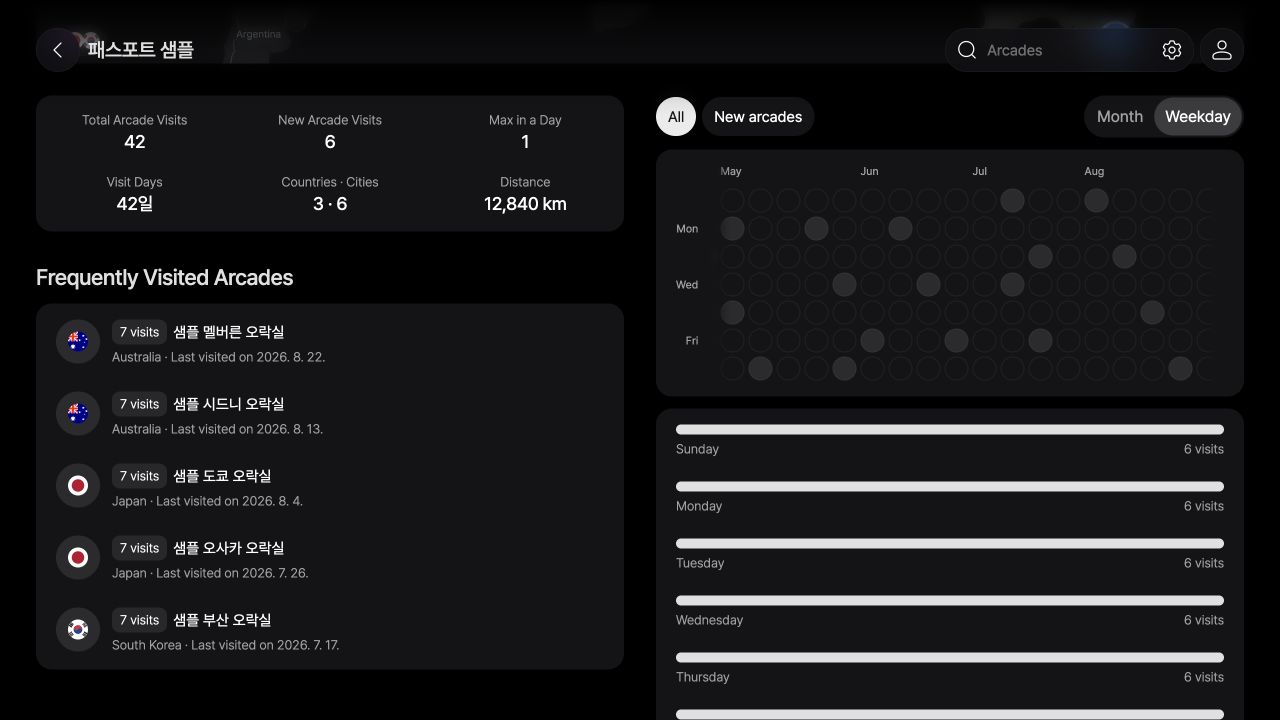
Visit activity and weekday totals in English. Sample account and venue names remain in Korean.
After saving, the user can view all-time or annual statistics and lists. Totals, places and daily activity come from the same data. The complete personal passport and the public profile apply their respective query scopes.
GPS checks and local dates
The interface checks location permission and GPS status before showing nearby candidates. When a visitor selects a place, the server rechecks authentication, visibility, operating status and coordinates. Conditions may have changed since the screen was opened.
The visit date uses server time converted to the arcade’s time zone. Repeating a request for the same account, arcade and local date returns the existing visit. The server also calculates totals, daily counts and map-place summaries, avoiding inconsistent aggregation of raw rows on different screens.
Passport statistics and profile visibility
Statistics, date-based lists and maps let users review places and regions they have visited. Return visits remain associated with their dates, revealing a pattern that search history alone cannot provide. The illustrations use sample visit data to demonstrate the interface.
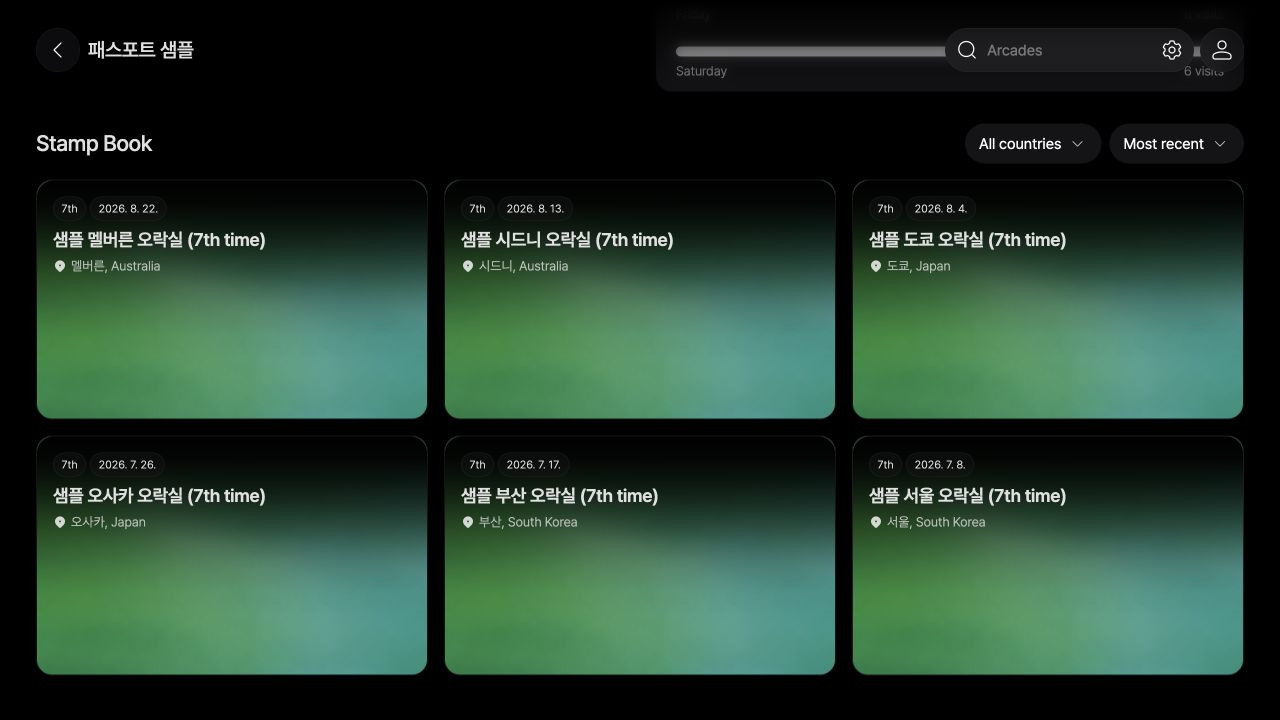
Passport stamp book in English, showing the same sample visits. Venue names retain their Korean sample labels.
Creating a visit does not publish every detail. Public profile queries return only what the visibility settings allow. Unreliable indoor GPS can prevent verification even on site, and a stamp does not certify the accuracy of the arcade document. The passport presents personal visits within those location-verification limits.